Why women aren't converting
The parable of the rich young girlboss

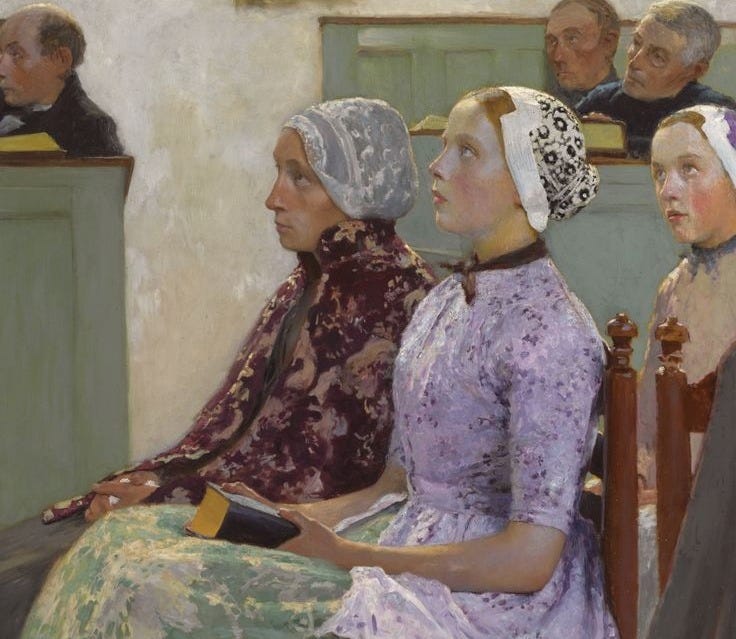
There have been many, many articles written about the influx of young people into the Church. Whether it’s a real phenomena or not depends on how you read the data1. The anecdotes, however, are numerous and all point in one direction: young people are joining theologically and morally conservative churches.
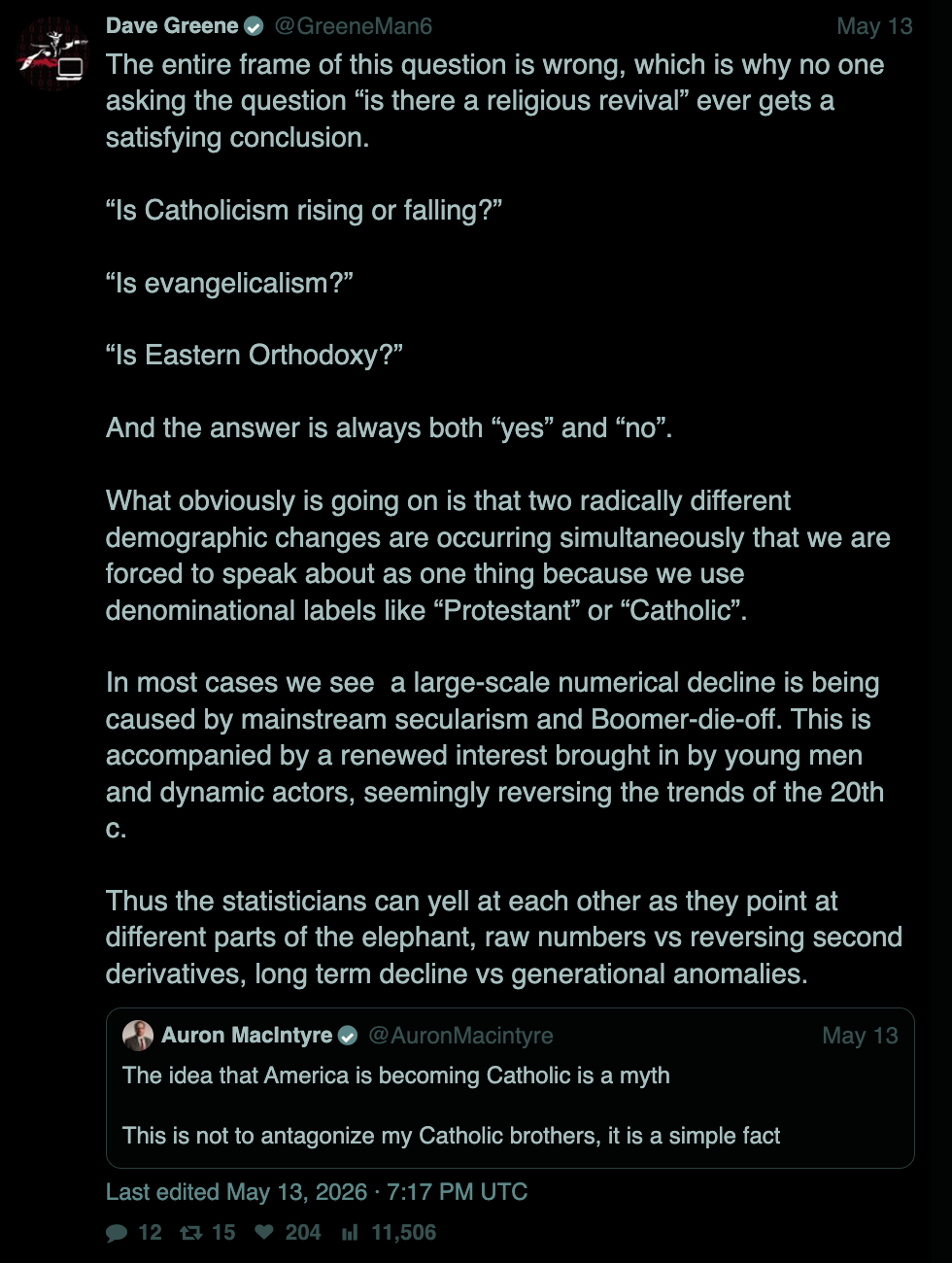
Specifically, young men are joining conservative churches. Young women’s religiosity is actually dropping.2 Anyone who is part of a conservative or traditionally-minded church can probably attest to this. Since 2020, there has been a flood of young men coming into churches. Young women are at best trickling in, and at worst are walking out the door. I generally see two ways that this gender gap is discussed on the Internet. On the one hand, there are users (mostly men) who decry women for being superficial and unfaithful. On the other, women lament how difficult religion is on women, and how it’s the churches faults that women are leaving. Both are correct, but not in the way they think.
I have seen young women (early-mid 20s) come into church on a Sunday, usually in the tow of a nervous but eager boyfriend. He has discovered the Latin Mass, he’s enamoured with it, he wants to show it to her. She’s young and gorgeous, her business casual outfit is sharp and flattering but out of place. She looks around, wondering if she could fit in in a place like this. The women in the pews her age are wearing long floral dresses and white chapel veils. Several of them carry children, either their own or a younger sibling. The young mothers wear no makeup to conceal the circles under their eyes. When young men walk into the Latin Mass, they are struck by its beauty and seriousness. When a young woman walks into the Church she is hit by beauty, yes, but also by what adopting a religious lifestyle would cost her.
The costs of a Christian lifestyle are, in a way, front-loaded for women and backloaded for men. For most young men, the biggest cost of joining is ceasing extra-marital sex. There’s a small minority for which this is too big of an ask, but in a landscape where fewer and fewer young men are having sex to begin with, it’s not usually a huge barrier. Beyond sexual ethics, men are not generally required to re-examine their priorities or their life’s orientation. A young man who is not discerning the priesthood can simply continue working their job and making progress towards financial preparation for marriage. If anything, a demanding religious framework is a plus, as young men today are looking for a challenge. This is not to say that the Christian life doesn’t give men their own crosses. For most men, the real challenge comes not at the starting point of conversion, but after marriage and children. They often find themselves stretched thin trying to provide financially and spiritually for a larger and larger family. Many men, especially those from secular backgrounds, don’t “get” just how much sacrifice is involved in life in a big family before they experience it. They imagine the wealth of having a beautiful wife and ten kids, but they don’t intuit the depth of the responsibilities. The secular young woman, on the other hand, sees a family of ten kids, and imagines giving birth ten times. She also correctly intuits that joining a religion that results in families of ten kids would mean upending her entire life before even getting to her wedding.
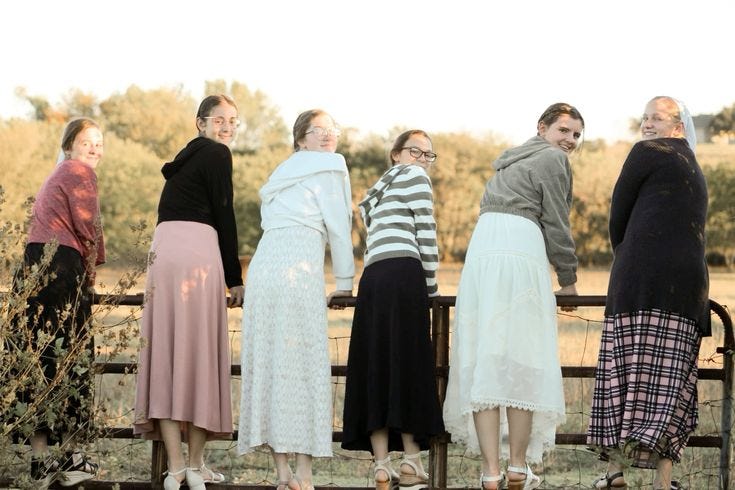
First there’s the superficial things. For one, the issue of modesty3. Most churches don’t have a prescriptive list of things women can and cannot wear. Most churches do have a consensus of what is and what isn’t acceptable. This consensus is something that women can intuit from looking at how the women around them are dressed. In most traditional churches, what is “kosher” is worlds away from what is considered acceptable in the secular world. And while changing something superficial like the way you dress may not seem like a massive issue to men, it is a huge deal for women. How you dress can be used to attract and deter male attention, sure. More importantly, it is a way to signal to other women. How you dress communicates everything from “I’m part of x group” to “I’m hotter than most of you and I know it”. Choosing to dress modestly means signalling to other women that you are not on the bleeding edge of the secular culture. In general women have a very difficult time accepting any deviation from the accepted norm, either from themselves or from women around them. As a result, you cannot be an “it girl” when you belong to a conservative Christian group. Downstream from this are all sorts of activities that have to be abandoned. No more clubbing. No Coachella. The thirst-trap vacation pictures on Instagram have to go too. You can still do pilates but you can’t wear skin-tight leggings while doing it. And most women don’t want to do pilates if they’re going to be the only girl in the studio doing it in sweatpants and a t-shirt. This can lead women to feel ostracized from their social circles of origin, even if no one within their social circle verbally objects to their conversion.
Then there’s the lifestyle changes. While not everyone is called to marriage, it is the normative path for Christian women. The average secular young woman has not been taught how to become marriageable, or how to find a good husband. Instead, her whole life is oriented around her career. She likely works long hours and has little flexibility in her schedule. If she’s been successful at school or at work, her five year plan may involve moving to a new city or even a new country. She probably spends a good deal of money on travel, or lives in an expensive area to shorten her commute. She may have large amounts of debt from student loans. All of these things, while not necessarily sinful, are habits which make the transition to marriage difficult. A woman who decides to convert, if she wants to be married, will need to make serious lifestyle changes. Instead of optimizing for mobility and independence, she will need to optimize for stability and support. She may want to be near family who can help her with child-rearing, which might mean trying to find a husband closer to home.
Marriage itself is a much riskier proposition when you’re coming from outside of a community. If a woman does convert to Christianity, she is then tasked with finding a husband without little to no family support. Women who grow up in traditional religious communities have an entire army of family and family friends who vet every man who shows even a modicum of interest. It can seem meddling and annoying, but if the family isn’t too overbearing, it’s a net positive. The horror story for a young religious woman is to end up with a useless husband who doesn’t work, or an abusive husband who actively threatens you and your kids. Family vetting drastically reduces the chances of a young woman choosing a monster or a bum. The family not only knows the young woman well, they also ideally know the potential suitor, and have a track record of behaviour they can use to make character judgements. In the secular world, families tend to have a “laissez-faire” approach to their kids’ dating lives. Young women with secular families do not benefit from any filtering mechanism and have to go through the gauntlet alone. Adding to the complexity, many women coming from a secular background will have sexual histories, which puts them at a disadvantage in a religious context.
If a woman does manage to successfully transition into a conservative religious group, find a good husband, and get married, her experience as a married woman from a secular background will also be challenging. It’s very possible that among her family and family friends, traditional marriage is stigmatized. Her family is probably unfamiliar with the challenges of raising 4+ kids. Her own mother probably works full time and may be unwilling and/or unable to provide support. Getting married also means becoming “uncool” and low status to people outside of her immediate family. As Johann Kurtz says, it’s embarrassing to be a stay at home mom. You don’t get to play the same status games as unmarried women, and society has basically nuked all the status games that were available to married women4. The exception of course, is weird mommy vlogger social media status games, which a lot of women rightly react poorly too. A married woman is meant to be hidden in a way that an unmarried woman is not5. Perhaps a topic to explore in depth another time, but I actually think that part of the backlash to the “tradwife” phenomenon has to do with people’s gut reactions to women sharing what should be private (children and family life) in a very public way.

In summary, a secular young woman who wants to convert into a conservative religious community must do the following:
Change the way that she dresses.
Ditch hobbies that are either sins or near occasions of sin, such as clubbing, reading “spicy” books, going to music festivals, watching the latest netflix show, etc.
In many cases sever ties with a previous social group, as women have a harder time than men being in a friend group that has a moral consensus that differs from their values.
Re-orient her life plans around marriage or a religious vocation. This may include changing a career path, working fewer hours, and moving closer to family.
Try to find marriage prospects when she may have a “rougher” past than other women in the community she would join, and no family help to filter bad suitors.
Lose status in the eyes of the world, which will restrict her opportunities and social circles.
Raise a family without the tight-knit clan and social support that women raised in religious contexts benefit from.
So yes, young women are correct when they say that conservative religions are hard on women. Conservative religions ask that you sacrifice, something that the secular world does not. In the secular world, the “girlboss” young woman is at the top of the heap. She is celebrated in the media, advertisements and products cater to her, and her 20s are basically a phase of boundless opportunity. From the point of view of a 20-something-year-old woman, it is entirely rational to choose the secular girl boss lifestyle. What men get right is that long term, pre-1960s style monogamous relationships do benefit women. It is far preferable to be an 80 year old matriarch with dozens of grandchildren and a loving husband than a single 80 year old woman with no one to care for her. But women in their 20s are not known for long term planning, and young women understand that obtaining a pre-1960s style monogamous relationship is not a simple endeavour in the modern world. The sacrifice of one’s status and lifestyle only truly make sense if you trade a materialist worldview for a spiritual one. In eyes of eternity, a person would be stupid not to choose Christ every time. After all, “what shall it profit a man, if he shall gain the whole world and lose his own soul”?
16 And behold, a man came up to him, saying, “Teacher, what good deed must I do to have eternal life?” 17 And he said to him, “Why do you ask me about what is good? There is only one who is good. If you would enter life, keep the commandments.” 18 He said to him, “Which ones?” And Jesus said, “You shall not murder, You shall not commit adultery, You shall not steal, You shall not bear false witness, 19 Honor your father and mother, and, You shall love your neighbor as yourself.” 20 The young man said to him, “All these I have kept. What do I still lack?” 21 Jesus said to him, “If you would be perfect, go, sell what you possess and give to the poor, and you will have treasure in heaven; and come, follow me.” 22 When the young man heard this he went away sorrowful, for he had great possessions.
Matthew 19:16-22
Related tweet from Dave Greene


Heck, a bunch of these are still pressures even if you grew up religious.
Solid read, but from an outsiders point of view, there is a simpler dynamic going on as well: status coding. If women see a bunch of low value dudes joining the church, they’ll perceive the church as low value. The only way the low values could beat this is organizing effectively and getting to critical mass, then commanding status this way. Regardless, normie women need to see high status women at the church adopting these norms, and also high value men. Tomothee Chalomet converting publicly to “trad cath” or whatever would make it high status and therefore desirable as well. But lots of “incels” flocking to church is inherently going to repel secular women.